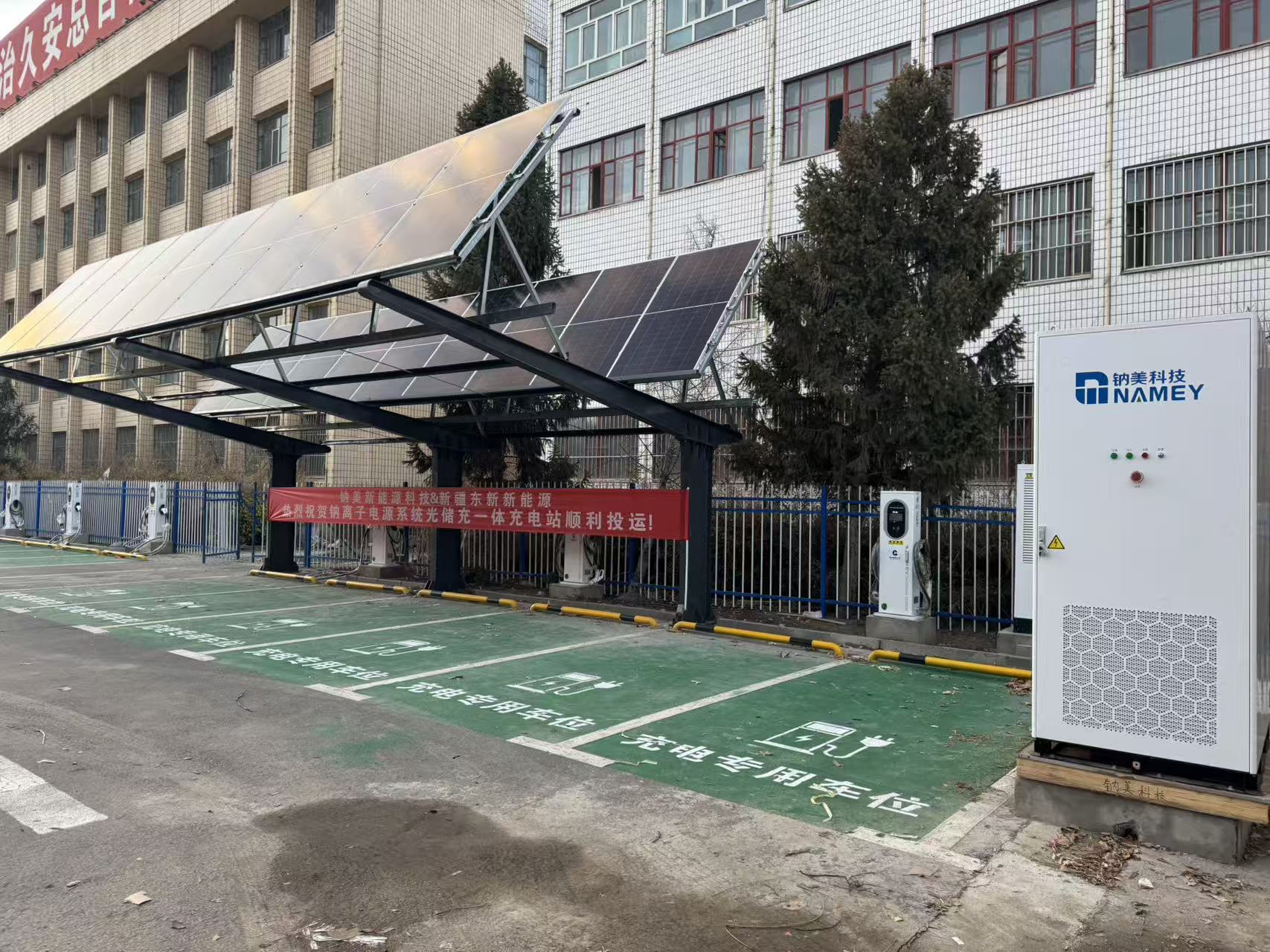
Recently, the "Sodium-ion Liquid-cooled Energy Storage System" independently developed by Namei Technology was officially put into operation in the first phase of the PV-Storage-Charging Integrated Demonstration Project in Qitai County, Changji Prefecture, Xinjiang. This is not only the first application of the company's sodium-ion battery products in the northwest market, but also Xinjiang's first benchmark project of sodium-ion PV-Storage-Charging integration.
As a key livelihood project for Qitai County to implement the national new energy development strategy, this project precisely targets the core pain point of "difficult charging" for new energy vehicles in the local area. Leveraging the advantages of sodium-ion batteries, such as abundant resource reserves, strong cost controllability, outstanding safety performance and excellent low-temperature adaptability, it has built a new energy service pattern featuring "addressing shortcomings, enhancing functions and expanding coverage".
The commissioning of the project will not only effectively alleviate the charging anxiety of local new energy vehicle owners and accelerate the popularization of new energy vehicles in Qitai County and even the northern Xinjiang region, but also promote the transformation of the transportation structure towards green and low-carbon development, providing a replicable and promotable practical model for the innovation of new energy application scenarios in northwest China.
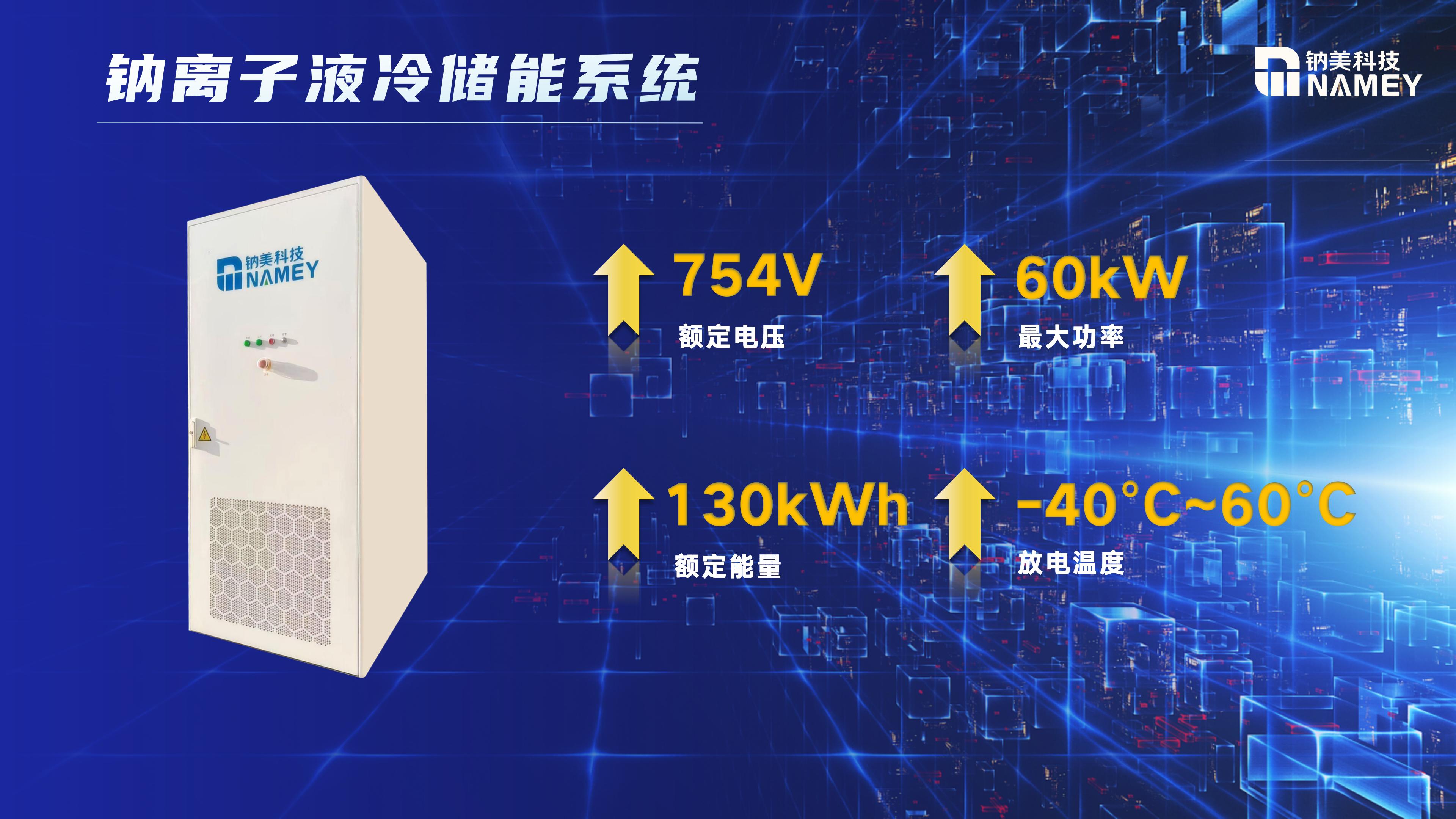
The Sodium-ion Liquid-cooled Energy Storage System is independently developed and designed by Namei Technology to address the harsh winter cold and complex environmental conditions in Xinjiang. The system is equipped with 5 sets of SP71173P175 prismatic sodium-ion battery modules, boasting a rated voltage of 754V, a maximum power of 60kW and a rated energy of 130kWh. With a discharge temperature range of -40℃ to 60℃, it is fully capable of adapting to the frigid winter temperatures in the region.
In addition, the cabinet is mainly composed of battery modules, liquid cooling units and pipelines, high-voltage boxes, PCS (Power Conversion System), BMS (Battery Management System), EMS (Energy Management System) and fire protection components. It can meet flexible deployment and configuration requirements, assist charging stations in peak-valley arbitrage, peak shaving and valley filling, dynamic capacity expansion, green power storage and other operations, thereby providing an innovative energy management mode.
As the "intelligent dispatching brain" of the entire charging station, the energy storage system can greatly improve the utilization efficiency of energy resources such as photovoltaic power and energy storage. It accurately formulates the usage strategy for each charging pile and plays a crucial role in the operation of the charging station.
To ensure the long-term stable operation of the project, Namei Technology will continuously track the system's operating status, collect real-time working condition data, operating parameters and user feedback. The company will conduct timely optimizations and upgrades to ensure precise adaptation between product performance and application scenarios, providing users with full-lifecycle technical support and service guarantees.
The successful commissioning of the sodium-ion liquid-cooled energy storage system is a concentrated manifestation of Namei Technology's R&D capabilities, and more importantly, a significant breakthrough in the large-scale application of sodium-ion batteries in the alpine regions of northwest China. In the future, Namei Technology will continue to deepen its presence in the new energy storage field, and with more innovative products and solutions, contribute to the achievement of the "dual carbon" goals!